
The glucomannan is one of the best-known ingredients in weight-management supplements. But what is it, what does research really show and how is it taken correctly and safely? In this guide you will find the basics, what officially applies in the European Union and 5 rules for correct use.
What glucomannan is
Glucomannan is a soluble dietary fibre that comes from the root (tuber) of the konjac plant (Amorphophallus konjac). The plant is grown mainly in Asia, where its flour has been used in cooking for centuries. A well-known example is shirataki noodles.
Its key characteristic is that it absorbs a large amount of water and forms a thick gel. That is why it is also used as a thickener in the food industry (E425), and why it always needs plenty of water when taken as a supplement.
Glucomannan at a glance
| Question | Answer |
|---|---|
| What is it? | A soluble dietary fibre from the konjac root. |
| Forms | Capsules, powder or as an ingredient in foods (e.g. shirataki). |
| Authorised EU claim | In the context of an energy-restricted diet, it contributes to weight loss.* |
| Amount | 3 g a day, in 3 doses of 1 g, before meals. |
| Most important | Always with 1–2 glasses of water. |
What officially applies in the European Union
In the EU, health claims for foods and supplements are allowed only if they have been assessed by EFSA and authorised (EU Regulation 432/2012). For glucomannan there are two authorised claims, each with specific conditions:
| Claim | Condition |
|---|---|
| Glucomannan in the context of an energy restricted diet contributes to weight loss.* | 3 g a day in 3 doses of 1 g, with 1–2 glasses of water, before meals, together with an energy-restricted diet. |
| Glucomannan contributes to the maintenance of normal blood cholesterol levels. | 4 g a day. |
The phrase «in the context of an energy-restricted diet» is not a detail. Glucomannan does not «slim you down on its own». It works as an aid within a nutrition programme, not instead of it.
What the research shows
Studies on glucomannan and weight do not all give the same result, and it is right that you know this:
- A 2015 systematic review concluded that in healthy overweight adults there is some evidence that, in the short term, it may help reduce body weight.
- A 2014 meta-analysis did not find statistically significant weight loss. A larger 2021 meta-analysis of weight-loss supplements concluded that the evidence is not sufficient to recommend them. Both called for better-designed studies.
The conclusion: glucomannan can be a helpful tool, under the conditions of the authorised claim. The result is determined mainly by the overall nutrition programme, movement and consistency.
5 rules for correct use
| Rule | Why |
|---|---|
| 1. Always with plenty of water | Glucomannan swells with water. Without enough fluid there is a risk of choking or obstruction. |
| 2. Before meals | This is what the conditions of the authorised claim provide: 1 g before each main meal. |
| 3. Together with a nutrition programme | The claim applies only in the context of an energy-restricted diet. |
| 4. Not before bedtime | It needs time and fluid to reach the stomach. |
| 5. Gradual increase | Like any fibre, it may cause bloating or wind at first. Start with a smaller amount. |
Who should be careful
- People who have difficulty swallowing: should not take glucomannan in capsules or powder.
- People taking medication: fibre may affect their absorption. Ask your doctor when to take them in relation to the supplement.
- People with diabetes, or who are pregnant or breastfeeding: discuss it with your doctor first.
- Children: weight-management supplements are not intended for children.
Glucomannan in Active Woman products

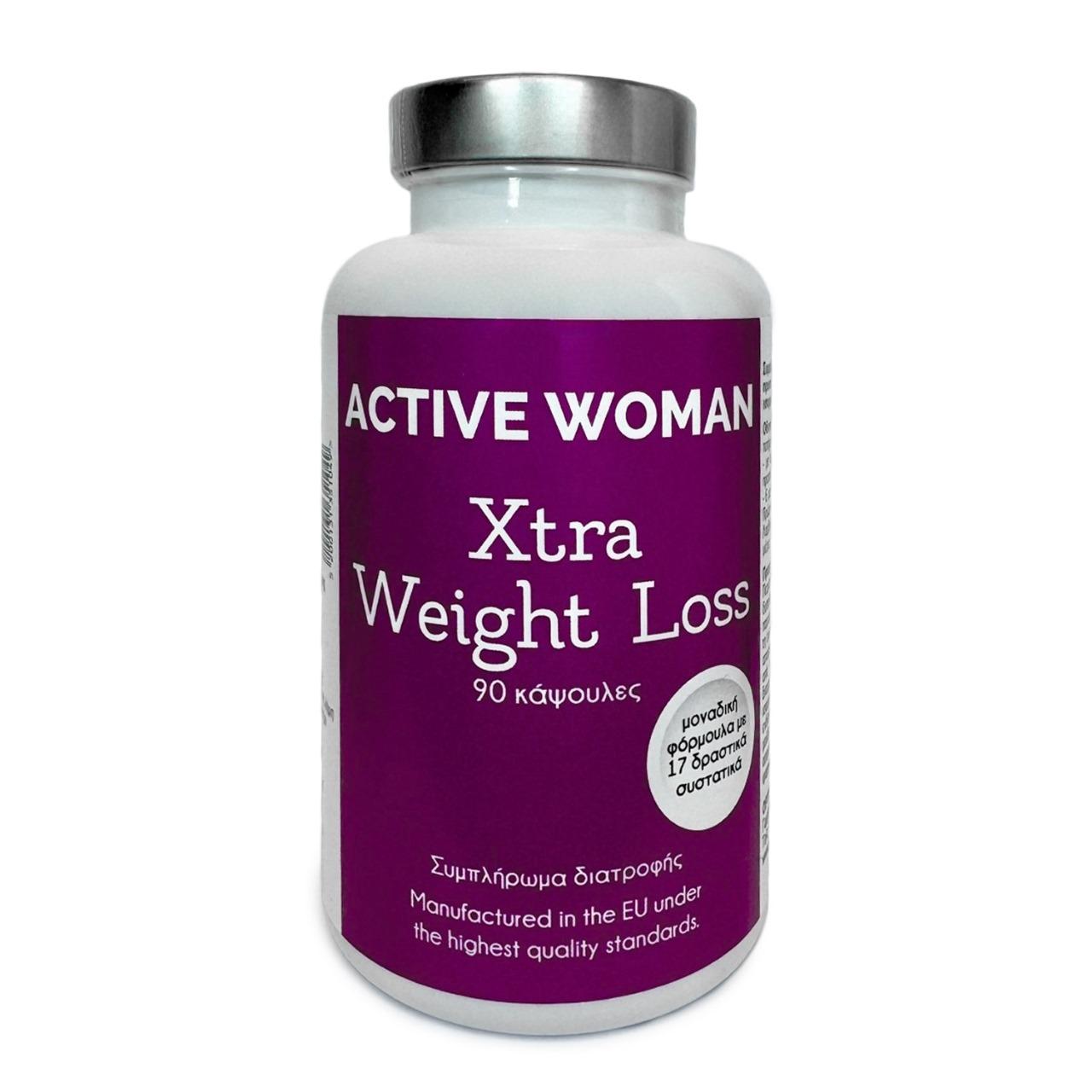
The Xtra Weight Loss contains 1,000 mg of glucomannan per 2 capsules, together with chromium, zinc, vitamin B6 and iodine. With 2 capsules 3 times a day, before meals and with 1–2 glasses of water, it provides the 3 g a day required by the authorised claim:
- Glucomannan in the context of an energy restricted diet contributes to weight loss.*
- Chromium contributes to the maintenance of normal blood glucose levels and to normal macronutrient metabolism.
- Vitamin B6 contributes to the reduction of tiredness and fatigue.
Xtra Weight Loss is also included in the pack Metabolism Support, together with Water Away and My Metabolisms.
Konjac glucomannan is also contained in My Fibre Plus, a fibre blend in powder form. It also contains sugar beet fibre, which contributes to an increase in faecal bulk.
*The beneficial effect is obtained with a daily intake of 3 g of glucomannan in three doses of 1 g each, together with 1–2 glasses of water, before meals and in the context of an energy-restricted diet. Swallowing without enough fluid may cause choking. Not recommended for people with difficulty swallowing.
Food supplements should not be used as a substitute for a varied and balanced diet and a healthy lifestyle.
The nutrition programme matters more
A supplement can help, but what makes the difference is a programme that fits your life. See the 7 rules for losing weight and what is true about metabolism. If you want a personalised programme, you can book online appointment or start with the Digital Diet.
Frequently asked questions
How much glucomannan is needed a day?
For the authorised weight-loss claim, 3 g a day in 3 doses of 1 g, before meals, with 1–2 glasses of water and an energy-restricted diet.
Does glucomannan make you slim without a diet?
No. The authorised claim applies only in the context of an energy-restricted diet.
Why does it need so much water?
Because glucomannan absorbs water and swells. With little fluid there is a risk of it getting stuck in the throat or oesophagus.
Can I take it in the evening before going to sleep?
It is not recommended. It is better taken before the main meals of the day.
Does it have side effects?
Like any fibre, it may cause bloating, wind or changes in bowel movements, mainly at first. A gradual increase and plenty of water help.
Do shirataki noodles have the same effect?
Shirataki are made from konjac and are very low in calories, so they can fit into a nutrition programme. But the amount of glucomannan differs from product to product.
Sources
- Regulation (EU) 432/2012 – List of authorised health claims.
- Zalewski BM, Chmielewska A, Szajewska H. The effect of glucomannan on body weight in overweight or obese children and adults: a systematic review of randomized controlled trials. Nutrition, 2015.
- Onakpoya I, Posadzki P, Ernst E. The efficacy of glucomannan supplementation in overweight and obesity: a systematic review and meta-analysis of randomized clinical trials. J Am Coll Nutr, 2014.
- Bessell E. et al. Efficacy of dietary supplements containing isolated organic compounds for weight loss: a systematic review and meta-analysis of randomised placebo-controlled trials. Int J Obes, 2021.
- Health Canada – Glucomannan and the risk of choking, 2010.
This article is for information purposes and is not a medical diagnosis, nor does it replace a doctor’s advice.