

The compound myo-inositol is one of the ingredients we hear about more and more, mainly in relation to polycystic ovary syndrome (PCOS). But what is it, where do we find it in food and what do studies really show? In this guide you will find the basics, what officially applies in the European Union and 5 things worth knowing before you take a supplement.
What is myo-inositol
Inositol is a substance chemically similar to sugars. It exists in several forms; the most common in the human body is the compound myo-inositol. Another form, D-chiro-inositol, is produced in the body from myo-inositol.
In cells, myo-inositol is a precursor of “messengers” that carry the signal of hormones such as insulin and follicle-stimulating hormone (FSH). That is why it is studied in conditions related to insulin resistance.
The body does not depend on diet alone: it produces myo-inositol itself from glucose, mainly in the kidneys, up to about 4 g a day. That is why it is not considered an essential nutrient or a “vitamin”.
Myo-inositol at a glance
| Question | Answer |
|---|---|
| What is it? | The most common form of inositol in the human body. |
| Where is it found? | Pulses, fruit, vegetables, wholegrain cereals, nuts. |
| From the diet | About 1 g a day in a Western-type diet. |
| Authorised EU claim | There is none for inositol. |
| Main area of research | PCOS and insulin resistance. |
Which foods contain it
Myo-inositol is found mainly in fresh fruit and vegetables and in seeds, i.e. pulses, cereals and nuts. The richest sources are considered to be:
| Food group | Examples |
|---|---|
| Pulses | Beans and peas, among the richest sources. |
| Fruit | Fresh fruit, such as citrus fruit and melon.* |
| Cereals | Wholegrain, where it is found mainly in the outer layer of the grain. |
| Nuts | Walnuts, almonds.* |
*In citrus fruit, melon and nuts, a large part of the inositol is present as phytic acid (IP6). Leafy vegetables contain the smallest amounts. A varied Mediterranean diet with pulses, fruit and wholegrains naturally provides myo-inositol.
What officially applies in the European Union
In the EU, a supplement may state that it “contributes” to something only if the claim has been assessed by EFSA and authorised (Regulation (EU) 432/2012). There is no authorised health claim for inositol. EFSA, for example, examined its relationship with cognitive function in 2009 and did not establish a cause-and-effect relationship.
This does not mean that the research is negative. It means that, legally, no supplement may promise a result from inositol. If you see such promises, be cautious.
What research shows for PCOS
Most studies concern women with polycystic ovary syndrome, where insulin resistance is common. The results do not all point in the same direction:
- A 2017 meta-analysis (9 randomised trials, 496 women) found a reduction in fasting insulin and the HOMA index with 1.1–4 g of myo-inositol a day for 12–24 weeks. An increase in SHBG was seen only when intake lasted at least 24 weeks. Some of the authors worked for a company that produces inositol.
- A 2023 meta-analysis (8 trials, 1,088 women) found no significant difference between myo-inositol and metformin in measures such as BMI, fasting insulin and HOMA.
- The review used for the 2023 international PCOS guidelines (30 trials, about 2,230 women) concluded that the evidence is limited and inconclusive. It found possible benefits for some metabolic measures and fewer gastrointestinal side effects compared with metformin.
- The 2018 Cochrane review on fertility (13 trials, 1,472 women) could not show whether myo-inositol increases live births or pregnancies, due to very low-quality evidence.
The conclusion: myo-inositol is still being studied as an ingredient. The review for the international guidelines suggests that the decision be made together with your doctor, based on the evidence and each woman’s needs. In any case, it does not replace diet, exercise or the treatment prescribed by your doctor.
5 things worth knowing
| What to know | Why |
|---|---|
| 1. Diet comes first | In PCOS, diet and exercise are the foundation. A supplement does not replace them. |
| 2. It takes time | In studies, intake lasted 12–24 weeks. Do not expect changes within a few days. |
| 3. Myo- and D-chiro-inositol | Some studies used a combination of the two in a 40:1 ratio. Check the label to see which form and how much the supplement contains. |
| 4. Generally well tolerated | Mild gastrointestinal discomfort (nausea, wind, diarrhoea) was reported mainly at a very high dose, 12 g a day. |
| 5. Talk to your doctor | Especially if you take medication for diabetes, hormonal preparations or are trying to conceive. |
Who should be careful
- Pregnancy and breastfeeding: only after discussing it with your doctor, especially if the supplement also contains herbs.
- People taking glucose-lowering medication: inform your doctor before you start.
- Teenagers: supplements should only be used under medical guidance.
Myo-inositol in Active Woman products
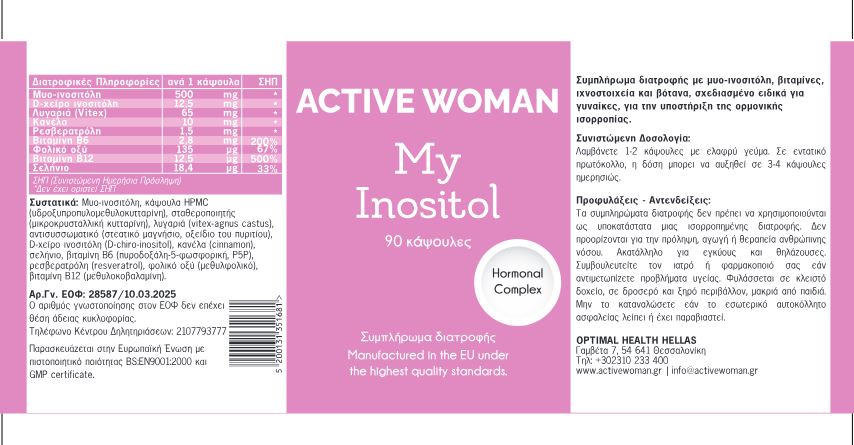
The My Inositol combines myo-inositol (500 mg) and D-chiro-inositol (12.5 mg) with vitamins B6 and B12, folic acid, selenium, chasteberry (Vitex agnus-castus), cinnamon and resveratrol. Inositol has no authorised claim; the product’s authorised claims relate to the vitamins and selenium:
- Vitamin B6 contributes to the regulation of hormonal activity and to normal energy-yielding metabolism.
- Vitamin B6, vitamin B12 and folate contribute to the reduction of tiredness and fatigue.
- Vitamins B6 and B12 contribute to the normal functioning of the nervous system.
- Selenium contributes to the protection of cells from oxidative stress and to normal thyroid function.
My Inositol is also available in the bundles Hormonal Health Support and Healthy Reproductive System Function.
Food supplements should not be used as a substitute for a varied and balanced diet and a healthy lifestyle.
Diet matters most in PCOS
If you have polycystic ovary syndrome, see what applies to diet in PCOS and to metabolism. For a personalised programme, you can book an online appointment or start with the Digital Diet.
Frequently asked questions
What is myo-inositol?
The most common form of inositol in the body. The body produces it itself and also gets it from foods such as pulses, fruit and wholegrain cereals.
Is it a vitamin?
No. It is not considered an essential nutrient, because the body produces it itself, up to about 4 g a day.
Does it help with PCOS?
Some studies show improvements in metabolic measures, but the review for the 2023 international guidelines described the evidence as limited and inconclusive. The decision is made together with your doctor.
How long does it take to see results?
In studies, intake lasted 12–24 weeks. There is no authorised claim for inositol, so no one can promise a specific result.
Does it have side effects?
It is generally well tolerated. Mild gastrointestinal discomfort was reported mainly at a very high dose (12 g a day).
How does it differ from D-chiro-inositol?
They are two forms of the same substance. The body converts part of myo-inositol into D-chiro-inositol, and some studies used a combination of the two in a 40:1 ratio.
Sources
- Regulation (EU) 432/2012 – List of authorised health claims.
- EFSA NDA Panel. Scientific Opinion on the substantiation of health claims related to inositol and cognitive function. EFSA Journal 2009;7(9):1304.
- Unfer V, Facchinetti F, Orrù B, Giordani B, Nestler J. Myo-inositol effects in women with PCOS: a meta-analysis of randomized controlled trials. Endocr Connect, 2017.
- Fatima K. et al. Effects of myo-inositol vs. metformin on hormonal and metabolic parameters in women with PCOS: a meta-analysis. Ir J Med Sci, 2023.
- Fitz V. et al. Inositol for Polycystic Ovary Syndrome: A Systematic Review and Meta-analysis to Inform the 2023 Update of the International Evidence-based PCOS Guidelines. J Clin Endocrinol Metab, 2024.
- Showell MG. et al. Inositol for subfertile women with polycystic ovary syndrome. Cochrane Database Syst Rev, 2018.
- Carlomagno G, Unfer V. Inositol safety: clinical evidences. Eur Rev Med Pharmacol Sci, 2011.
- Caputo M. et al. Inositols and metabolic disorders: From farm to bedside. J Tradit Complement Med, 2020.
This article is for information purposes and is not a medical diagnosis, nor does it replace a doctor’s advice.
